Documented place · living community
South Shore carries the history and heritage of Tampa Bay in concentrated form.
From Ruskin, Apollo Beach, Gibsonton, Wimauma, Sun City Center, southern Riverview, Balm, and the Alafia–Little Manatee corridor, the regional record gathers water, migration, agriculture, enterprise, cultural exchange, faith, service, and repeated reinvention.
The central interpretation
Tampa Bay becomes intimate along South Shore.
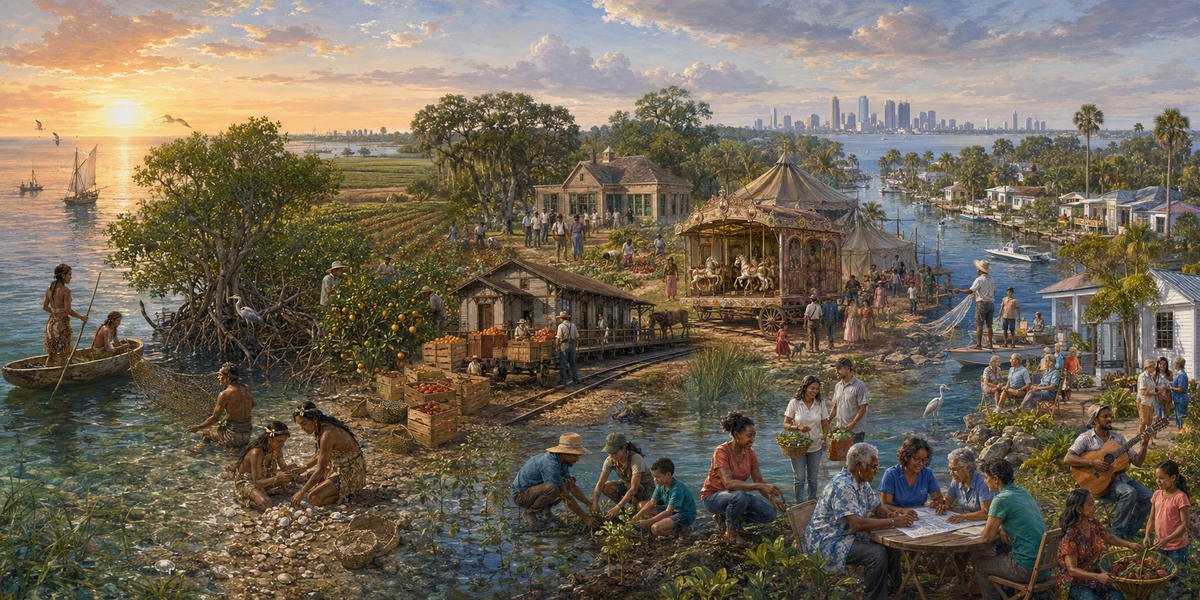
South Shore is a living regional memory held in rivers, tomato soil, church grounds, rail traces, carnival workshops, mangrove roots, canals, family stories, and communities learning how to carry their inheritance forward. Tampa’s historic core contributes the port, railroads, cigar factories, finance, and urban immigration. South Shore enlarges the account through estuarine life, farms, railroad settlements, cooperative education, Black community formation, Latino agricultural heritage, show-business culture, waterfront development, retirement migration, and environmental stewardship.
1 · The first regional world
The South Shore story begins with the bay itself.
Long before modern municipalities, Tampa Bay formed a connected Indigenous maritime world. Communities lived through fishing, gathering, hunting, shell-working, canoe travel, and exchange across the estuary. The Mocoso occupied the Hillsborough Bay and Alafia River area; the Uzita lived from the Little Manatee River southward; and the Tocobaga and Pohoy occupied other portions of the bay. These communities belonged to a wider cultural and political landscape crossing present county boundaries.
The South Shore coastline therefore represents an ancient center of Tampa Bay life. Sixteenth-century Spanish expeditions entered this interconnected world. National Park Service archaeological context places Hernando de Soto’s Tampa Bay camp near the mouth of the Little Manatee River and describes movement across the Alafia. These encounters brought violence, disease, displacement, and profound political disruption throughout the bay.
Tampa Bay History Center: Florida’s early American IndiansNational Park Service archaeological context
2 · The regional connective tissue
Water has always joined South Shore to the wider region.
The Alafia River, Little Manatee River, Hillsborough Bay, Cockroach Bay, and the open estuary have served as pathways, food sources, ecological nurseries, and places of settlement. This water-centered inheritance connects South Shore with Safety Harbor and the northern bay, Tampa’s harbor and commercial waterfront, St. Petersburg and the Pinellas peninsula, Terra Ceia and the Manatee River country, Sarasota Bay, and the broader Gulf Coast.
The bay remains the regional center of gravity. South Shore occupies one of its fertile meeting places: river, estuary, agricultural plain, and Gulf-facing coastline.
3 · Soil, rail, and cooperative life
South Shore supplied an agricultural foundation beneath urban Tampa Bay.
As Tampa grew through railroads, cigar manufacturing, phosphate shipping, military activity, and port commerce, southern Hillsborough developed through citrus, cattle, vegetable cultivation, nurseries, sawmills, turpentine production, and especially tomatoes.
Wimauma emerged along a railroad corridor in the early twentieth century. Rail access carried citrus and vegetables from inland farms toward packing centers, Tampa, and national markets. Its documented history begins with nineteenth-century citrus cultivation and expands through the railroad town founded in 1902.
Ruskin followed in 1908 as a cooperative community founded by George and Adeline Miller and named for British social thinker John Ruskin. The Ruskin Commongood Society collectively supported Ruskin College, a general store, and two parks. Agriculture, particularly tomatoes, became central to local identity. Ruskin therefore contributes a distinctive Tampa Bay chapter in which education, cooperative economics, useful work, civic beauty, and agriculture gathered into one community experiment.
Hillsborough County: Wimauma historic resourcesHCC Wimauma CollectionHillsborough County: Community of RuskinSocialism in the Sunshine: The Roots of Ruskin
4 · Labor, migration, and belonging
South Shore reveals whose work sustained the region.
Wimauma’s Bethune area preserves African American history involving agriculture, forestry, turpentine work, churches, schools, family networks, and community institution-building under segregation. Contemporary scholarship is restoring these lives to the regional account and recognizing Black residents as makers of Wimauma’s economic and civic foundations.
Beginning especially in the later twentieth century, Mexican, Central American, Caribbean, and other Latino families became increasingly central to agricultural production and community life. Their labor, churches, businesses, foodways, language, and family networks form a major part of present-day South Shore heritage.
This history belongs beside Ybor City’s Cuban, Spanish, Italian, Afro-Cuban, and wider immigrant story. Together they reveal a Tampa Bay repeatedly shaped by people arriving through different routes and transforming work into community.
University of South Florida: Reconstruction of Wimauma’s Bethune AreaHillsborough County: Black history across the region
5 · American popular culture
Gibsonton gives Tampa Bay a nationally distinctive cultural chapter.
Gibsonton became a winter home and permanent community for circus, carnival, and sideshow professionals. Residents built businesses, repaired equipment, developed performance traditions, organized civic services, and created a place where traveling show people could belong. Local accommodations and zoning supported trailers, rides, equipment, and animals, and the International Independent Showmen’s Association preserves an archival inheritance extending across American popular entertainment.
Gibsonton adds performance, spectacle, craftsmanship, entrepreneurship, mutual care, and unconventional community-making to Tampa Bay’s cultural identity. This history deserves presentation through the dignity, agency, skill, civic leadership, and full humanity of the people who made it.
Hillsborough County: Gibsonton and the TomainisUSF Showmen’s Museum Photograph Collection
6 · The postwar shoreline
Apollo Beach and Sun City Center express the postwar transformation of Tampa Bay.
Apollo Beach began as farmland and grazing land associated with the Dickman family. Mid-century development transformed portions of the low coastal landscape into a canal-oriented residential community. Sun City Center, opened by Del Webb in 1961, embodied the growth of planned active-retirement communities through clubs, recreation, volunteerism, health services, and a self-contained community model.
These communities connect South Shore to the metropolitan region’s postwar expansion through automobile-centered development, air conditioning and year-round growth, waterfront engineering, migration from northern states, retirement and healthcare economies, and development along U.S. 41 and Interstate 75.
HCC Apollo Beach CollectionSun City Center: Something New under the Sun for Retirees
7 · Heritage carried into the future
Present growth makes memory and stewardship urgent.
South Shore now stands among the metropolitan area’s major growth corridors. Former fields, groves, wetlands, and rural roads increasingly carry housing, schools, healthcare facilities, commerce, and transportation infrastructure. Responsible regional growth calls for durable preservation of Indigenous, Black, Latino, agricultural, immigrant, working-class, faith, civic, and showmen histories.
That stewardship also belongs to the physical inheritance: mangroves, seagrass, wetlands, fisheries, water quality, flood preparedness, storm-surge awareness, heat resilience, and the long health of the estuary. Prosperity gains depth when it reaches the families whose labor sustained the region and strengthens the people already serving within it.
Education, faith, and continuing community service
The heritage lives through institutions and relationships.
Churches, Christian schools, public libraries, civic institutions, healthcare and human-service organizations, cultural organizations, farms, businesses, and residents have contributed to regional life across generations. Ruskin Christian School records service to the South Shore community since 1968 under the leadership of First Baptist Church.
The living record welcomes source suggestions, oral-history leads, church archives, photographs with permission, and corrections. Every contribution moves through attribution, permission, privacy, cultural, and editorial review before public use, preserving truthful memory, human dignity, cross-cultural service, and widening participation.